While writing my last post it occured to me that artwork geared toward children is sometimes forgotten by the artworld.
Children's literature, movies, music, poetry-- some of it I enjoy more than most adult artwork.
But can we compare the two?
Can we compare the poetry of Shel Silverstein with the poetry of TS Eliot?
Is there a imaginary line drawn between artwork for children and for adults? And can we measure them by the same standards?
Sunday, May 2, 2010

Response to Tyler's Response to Skyla
Question: Is N'Sync bad art? Does their popularity, however fleeting, warrant the title of "good art?"If Susie got Mitch's message, and Susie alone, did Mitch succeed as an artist?
N*sync never sought to be considered "good art." Their music was not geared to 30 something intellectuals. but 12 year old teeny boppers. The message of their songs were not in the lyrics, or the musical quality of the songs. The message was in the package, in the overly-repetitive "catchy" melodies, and flashy sweatsuits.
And the message wasn't much of a message anyways.
Except that it entertained.
So if the message was just that. To entertain 12 year olds.
Does that make it art?
Does that make it good art, because it did very succesfully so, entertain the tweens of the 90's?
I dont know? There is a difference between an entertainer and an artist. And N'Sync, definately fits more comfortably into the first category.
N'Sync, were very good entertainers. But the artistic quality of their works go unappreciated by most members of the artworld, because their audience was not the artworld. It was the world of entertainment.
Question:
What do you think? If an artist's purpose is to entertain, does that make him or her an artist or an entertainer?
N*sync never sought to be considered "good art." Their music was not geared to 30 something intellectuals. but 12 year old teeny boppers. The message of their songs were not in the lyrics, or the musical quality of the songs. The message was in the package, in the overly-repetitive "catchy" melodies, and flashy sweatsuits.
And the message wasn't much of a message anyways.
Except that it entertained.
So if the message was just that. To entertain 12 year olds.
Does that make it art?
Does that make it good art, because it did very succesfully so, entertain the tweens of the 90's?
I dont know? There is a difference between an entertainer and an artist. And N'Sync, definately fits more comfortably into the first category.
N'Sync, were very good entertainers. But the artistic quality of their works go unappreciated by most members of the artworld, because their audience was not the artworld. It was the world of entertainment.
Question:
What do you think? If an artist's purpose is to entertain, does that make him or her an artist or an entertainer?
Tuesday, April 20, 2010
Response to Aurora's IS THERE NO GOOD IN THE WORLD?
question: "i'm trying to learn how to teach in a way that will lead our youth toward more ethical lifestyles through the themes and messages of literature. how does art and philosophy collide in a way that can change the future?"
philosophy, to me, seems to be simply put, is the study of problems--problems that come with existence on this earth.
everyone in life has some kind of philosophy that generally guides them, whether they consciously know it or not.
art is expression. it has the ability to affect, persuade, change, and enlighten an audience. it is a mechanism in which we put out our own philosophy's and truths about life into the universe.
these subjects go hand in hand, and could play potential huge roles in changing the future. infact, they have changed our futures, and contributed greatly to our history.
i would go as far as to say that it is the writers, and artists, and musicians that have brought on the change in the world we experience.
question: do you think that art can exist without philosophy? vice versa?
philosophy, to me, seems to be simply put, is the study of problems--problems that come with existence on this earth.
everyone in life has some kind of philosophy that generally guides them, whether they consciously know it or not.
art is expression. it has the ability to affect, persuade, change, and enlighten an audience. it is a mechanism in which we put out our own philosophy's and truths about life into the universe.
these subjects go hand in hand, and could play potential huge roles in changing the future. infact, they have changed our futures, and contributed greatly to our history.
i would go as far as to say that it is the writers, and artists, and musicians that have brought on the change in the world we experience.
question: do you think that art can exist without philosophy? vice versa?
The Ever Changing World of Art
The world is contantly changing it's face, and with each generation a new form and style of art is born. Keeping up with this ever changing world, while maintaining appreciation for old style art and new styles, is an incredible feat. One has to analyze why a particular generation favored a particular style of art, and deem whether their perception of it was rational. This is the goal of an art critic--forming a rational basis for what is good and what isn't.
During the time period of Impressionist paintings, many art critics of the time dissmissed their works, while now their works are put on a pedestal. Academic painters once glorified, are now lost in time.
One observation is that art seems to be as fickle as fashion.
My question is this: In an ever changing world, is art always subjective to the time? Does it come and go like a trend?
During the time period of Impressionist paintings, many art critics of the time dissmissed their works, while now their works are put on a pedestal. Academic painters once glorified, are now lost in time.
One observation is that art seems to be as fickle as fashion.
My question is this: In an ever changing world, is art always subjective to the time? Does it come and go like a trend?
Response to Lisa Diamond's Post About Danto
Question: "Danto claims that only someone who has studied art’s history has an “eye” for art. However, haven’t there been plenty of great artists in the past create great works of art without knowing the history?"
Saying that someone who has studied art's history has an "eye" for art causes art to become a subject for only the elite. However, that's not to say that studying art history is not beneficial. Learning about an artwork's history provides a new, different and seperate perspective--the keyword here being seperate, as in seperate from having an "eye" for art. But I'll get to that in a second.
Someone who know's the artwork's history, can better undesrtand the mind frame of the artist--perhaps what time period it is depicting, how it related to world events at the time, the culture that influenced the paitning, and the style of painting. This does not mean they can accurately judge whether a painting is worthy of being called art. It just means that one can deduce where and how the artwork came to be.
Having an eye for art, refers to art critiscm, which is distinguised from art history. Art critiscm is more concered with the aesthetic value of an artwork.
Having knowledge in art history may be beneficial to you while judging art, but having that extra knowledge, I believe, does not ensure an "eye" for the subject. Personally, I would say that in order to have an "eye" art one must have the mindset of an artist, or be one themselves.
Question: What are the guidelines for critiquing art? What makes a good critic? And do you believe that only an artist can truly judge a work of art, and sufficiently critique it?
Saying that someone who has studied art's history has an "eye" for art causes art to become a subject for only the elite. However, that's not to say that studying art history is not beneficial. Learning about an artwork's history provides a new, different and seperate perspective--the keyword here being seperate, as in seperate from having an "eye" for art. But I'll get to that in a second.
Someone who know's the artwork's history, can better undesrtand the mind frame of the artist--perhaps what time period it is depicting, how it related to world events at the time, the culture that influenced the paitning, and the style of painting. This does not mean they can accurately judge whether a painting is worthy of being called art. It just means that one can deduce where and how the artwork came to be.
Having an eye for art, refers to art critiscm, which is distinguised from art history. Art critiscm is more concered with the aesthetic value of an artwork.
Having knowledge in art history may be beneficial to you while judging art, but having that extra knowledge, I believe, does not ensure an "eye" for the subject. Personally, I would say that in order to have an "eye" art one must have the mindset of an artist, or be one themselves.
Question: What are the guidelines for critiquing art? What makes a good critic? And do you believe that only an artist can truly judge a work of art, and sufficiently critique it?
Wednesday, April 14, 2010
Response to Tyler's Response
"Is it necessary that our aesthetics and ethics are wedded as such? Does this play an important role in our society, such as in courtship? If we overlook our spouses bad qualities because of his strong chin or her curvy waist, isn't that natural selection at work, which is "good" for us as a species? Is it necessary?"
Aesthetics is necessary with regards to natural selection. In fact, many animals use their aesthetic qualities in order to attract mates. Take the peacock for example, who spreads it's beautiful expanse of feathers in hopes of drawing the attention of the female. Is it necessary? Well, noticing the aesthetic value of a person/object/etc.is instinctual. It's part of human nature, and nature in general. However, while we as humans are drawn to those things we find beautiful, it is not always the most important factor in choosing a mate.
Perhaps if a stranger to the pretty girl saw her litter, they may let it slide. However, people who knew her may have had a different reaction.
So yes, it is necessary. In order for one to be drawn to something, it must be aesthetically desirable to them. However, once you get past the aesthetic value of something, there are many other contributing factors. At first it may be possible to overlook someone's bad qualities because of their good nose, but eventually, they will get to you.
Like my mother always says, beauty is only skin deep.
Aesthetics is necessary with regards to natural selection. In fact, many animals use their aesthetic qualities in order to attract mates. Take the peacock for example, who spreads it's beautiful expanse of feathers in hopes of drawing the attention of the female. Is it necessary? Well, noticing the aesthetic value of a person/object/etc.is instinctual. It's part of human nature, and nature in general. However, while we as humans are drawn to those things we find beautiful, it is not always the most important factor in choosing a mate.
Perhaps if a stranger to the pretty girl saw her litter, they may let it slide. However, people who knew her may have had a different reaction.
So yes, it is necessary. In order for one to be drawn to something, it must be aesthetically desirable to them. However, once you get past the aesthetic value of something, there are many other contributing factors. At first it may be possible to overlook someone's bad qualities because of their good nose, but eventually, they will get to you.
Like my mother always says, beauty is only skin deep.
Tragedy & Art
In order create an artwork that causes emotion, I believe, one must feel the emotion strongly enough to depict it. You can for the most part, tell when an artwork was done half-heartedly because it fails miserably at it's attempt to make you feel something.
However, one thing I have always noticed with literature particularly is that most great literature stems from conflict, depression, tragedy.
We as humans, are drawn to it. It is in our nature.
Do you believe that artwork that depicts these things is most effective? Is this perhaps why there is so much of it? Do you think art can exist without tragedy?
However, one thing I have always noticed with literature particularly is that most great literature stems from conflict, depression, tragedy.
We as humans, are drawn to it. It is in our nature.
Do you believe that artwork that depicts these things is most effective? Is this perhaps why there is so much of it? Do you think art can exist without tragedy?
Thursday, April 8, 2010
Response to Aurora's response to DJK
question: what are other consequences of not having a set definition for art?
the consequences? or potential benefits?
in any case, here's what would change:
for one thing allows us to not be narrow-minded in what we consider art. this allows us to take creative liberties. in the field of art, it allows us to be more well-rounded. science and math play huge roles in design, and in the same way many other subjects flow over and overlap with others.
do you find that a definition of art changes the way we view aesthetics by very much? or very little?
the consequences? or potential benefits?
in any case, here's what would change:
for one thing allows us to not be narrow-minded in what we consider art. this allows us to take creative liberties. in the field of art, it allows us to be more well-rounded. science and math play huge roles in design, and in the same way many other subjects flow over and overlap with others.
do you find that a definition of art changes the way we view aesthetics by very much? or very little?
Response to Zach's Response
Question: Is there another way of looking at this more optimistically and is the possibility of art dying out like a fad in the future plausible?
I think there are two groups that this question is applicable too. I know the world isn't divided into two different groups, but we can safely say that there are those who take time to smell the roses, and those that don't.
The first group enjoys thinking through things, and taking time to think. The second are those that enjoy the movement of things without stopping to wonder.
To the first group perhaps, technology would not crush or overshadow art. Those who are sincerely interested, would use technology to seek out art, and not do away with it. With the second group, art has a very high possibility of dying out, because it is not on their highest level of importance-- not a priority amongst facebook, twitter, etc.
Question: If art ceases to exist, what do you think will be the first thing the human race will lose?
I think there are two groups that this question is applicable too. I know the world isn't divided into two different groups, but we can safely say that there are those who take time to smell the roses, and those that don't.
The first group enjoys thinking through things, and taking time to think. The second are those that enjoy the movement of things without stopping to wonder.
To the first group perhaps, technology would not crush or overshadow art. Those who are sincerely interested, would use technology to seek out art, and not do away with it. With the second group, art has a very high possibility of dying out, because it is not on their highest level of importance-- not a priority amongst facebook, twitter, etc.
Question: If art ceases to exist, what do you think will be the first thing the human race will lose?
Tuesday, April 6, 2010
Is This Art?
While scrolling through the newest iPhone Applications (there really is an app for everything), I came across this. Apparently our iPhones have solved the dilemna that we have been endlessly pondering in class: What is art and what isn't?
The description of the app:
"The Is This Art? iPhone application is a new tool designed for people who have questions about the artistic integrity of their surroundings. Using your iPhone's camera and a complex, revolutionary algorithm, we now have the ability to instantly provide users with an authoritative declaration of artistic importance."
Basically you take a picture, and your iPhone gives you a kind of sarcastic, tongue-in-cheek response, such as
I can't find Waldo, therefore THIS IS ART.
My mother would think this is crap, therefore THIS IS ART.
Obviously, the application is a kind of joke, but not really. I like it because, the responses while they do not have any intellectual value theyb remind us that we are constantly prodding the boundaries of art, testing creative limits, and widening the area of what is considered art. Take music for example--what is considered music during the 60's was not well accepted by those that loved the music of the 50's.
I thought that the application was neat, because it allows us to take a closer look--a second glance, at what we are surrounded by.
Question: Do you think that technological advances have helped make the art world less elitist? Has it helped furthered the arts? Caused our society to pay mor attention to it? Or has it overshadowed it/demoralized it?
Oh and heres the link, incase anyone wanted to check it out: http://isthisart.org/
The description of the app:
"The Is This Art? iPhone application is a new tool designed for people who have questions about the artistic integrity of their surroundings. Using your iPhone's camera and a complex, revolutionary algorithm, we now have the ability to instantly provide users with an authoritative declaration of artistic importance."
Basically you take a picture, and your iPhone gives you a kind of sarcastic, tongue-in-cheek response, such as
I can't find Waldo, therefore THIS IS ART.
My mother would think this is crap, therefore THIS IS ART.
Obviously, the application is a kind of joke, but not really. I like it because, the responses while they do not have any intellectual value theyb remind us that we are constantly prodding the boundaries of art, testing creative limits, and widening the area of what is considered art. Take music for example--what is considered music during the 60's was not well accepted by those that loved the music of the 50's.
I thought that the application was neat, because it allows us to take a closer look--a second glance, at what we are surrounded by.
Question: Do you think that technological advances have helped make the art world less elitist? Has it helped furthered the arts? Caused our society to pay mor attention to it? Or has it overshadowed it/demoralized it?
Oh and heres the link, incase anyone wanted to check it out: http://isthisart.org/
Sunday, April 4, 2010
Response to Katherine
Do people benefit from reading art reviews from critics who may have different tastes than themselves?
Yes, I believe people do benefit from reaedin these art reviews. The way Hume seemed to describe characsteristics of critics sounded more like process than anything. A critic is someone who intinctually feels something but is able to observe, strip it down, look at from different points of view-subjectively and objectively, etc. This takes practice. If a person wants to be able to do this, they must be sensitive to understanding different tastes, whether or not they find them agreeable.
Yes, I believe people do benefit from reaedin these art reviews. The way Hume seemed to describe characsteristics of critics sounded more like process than anything. A critic is someone who intinctually feels something but is able to observe, strip it down, look at from different points of view-subjectively and objectively, etc. This takes practice. If a person wants to be able to do this, they must be sensitive to understanding different tastes, whether or not they find them agreeable.
Born an artist?
I read an article today that discussed art in preschools, and how it is taught today. It had interviewed a woman that ran an community art school. She noticed a decreased attendance in her children's art classes. When asked why, she explained that she felt a number of parents didn't feel that enrolling their child in art classes was worth anything if there was no finished product in the end. If the art that they came up with resembled anything learnt outside the school, it meant they were not learning anything.
We are all born with the same ability to create, to express ourselves through some medium. My question is this: In a society where so much emphasis is put on success and failure, are we trading in our instinctual urge to create for a finished product?
We are all born with the same ability to create, to express ourselves through some medium. My question is this: In a society where so much emphasis is put on success and failure, are we trading in our instinctual urge to create for a finished product?
Wednesday, March 24, 2010
Emotional Response & Art
In class we've talked about abstract, realistic art, and emotional response. This is my take on the different responses gained from each type of art.
While looking at an abstract painting, and not a realistic representation, one is forced not tie in conotations with what they are viewing. For example, if you're looking at a painting of a tree, all your conotations of a tree also become part of the experience. A tree might represent growth, the environment, stability, etc.
Therefore the emotional response would be deduced response, requiring reasoning and logic. The message here is gained through what we already know, and it is up to the viewer to draw their own conclusions of the message.
However, in an abstract artwork there is no representation or symbolic meaning. All other knowledge is left out, and what the viewer is left with is what he is experiencing here, in that moment. The message here I believe lies on an instinctual response.
But what about art that is both abstractual and realistic--painting's that use real images as a starting point for conveying an abstract image? Would this surpass the response drawn from both abstract and realistic art?
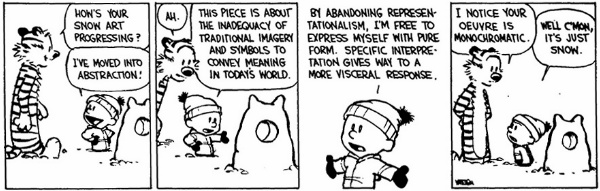
While looking at an abstract painting, and not a realistic representation, one is forced not tie in conotations with what they are viewing. For example, if you're looking at a painting of a tree, all your conotations of a tree also become part of the experience. A tree might represent growth, the environment, stability, etc.
Therefore the emotional response would be deduced response, requiring reasoning and logic. The message here is gained through what we already know, and it is up to the viewer to draw their own conclusions of the message.
However, in an abstract artwork there is no representation or symbolic meaning. All other knowledge is left out, and what the viewer is left with is what he is experiencing here, in that moment. The message here I believe lies on an instinctual response.
But what about art that is both abstractual and realistic--painting's that use real images as a starting point for conveying an abstract image? Would this surpass the response drawn from both abstract and realistic art?
Sunday, March 7, 2010
Response to Misty's post
Question: do you agree that artists create better work a majority of the time, when they are just expressing themselves, instead of trying to make money
I think this is subjective.
For example, an artist that is solely producing for the sake of self expression is going to produce alot of shit. Kind of like when you write a poem in your journal and its unedited, completely sparatic and embarassing to share with other people. However, every once in a while you may get something awesome.
An artist that produced to make money, to meet a deadline etc is usually someone who's talent becomes their profession. they may produce paintings greater than just anyone on the street, because that is their skill. Some people work better under pressure like this, such as working as an artist for a living, rather than leisurely creating art.
So like I said, I think it's pretty subjective.
Personally, I prefer art purely for the sake of expression. No matter how good a painting is, I want to believe the intentions during the creative process were solely to deliver a message, a meaning.
I think this is subjective.
For example, an artist that is solely producing for the sake of self expression is going to produce alot of shit. Kind of like when you write a poem in your journal and its unedited, completely sparatic and embarassing to share with other people. However, every once in a while you may get something awesome.
An artist that produced to make money, to meet a deadline etc is usually someone who's talent becomes their profession. they may produce paintings greater than just anyone on the street, because that is their skill. Some people work better under pressure like this, such as working as an artist for a living, rather than leisurely creating art.
So like I said, I think it's pretty subjective.
Personally, I prefer art purely for the sake of expression. No matter how good a painting is, I want to believe the intentions during the creative process were solely to deliver a message, a meaning.
Photography as an Art Form
A while ago, we were discussing how some people would argue that photography was not an art form--that capturing an image was merely capturing an image. While surfing the internet I came across this entitled, 10 Reasons Why Photography Sucks and Isn't an Art Form, the author was playing a sort of devils advocate and came up with these reasons.
So today, I'm going to write an opposition on a few of the points he makes.
1 - "Anyone can do it." - While I agree that the point and shoot cameras make photography an accessible art form to anyone, this does not mean that anyone can do it. And I hardly believe that if we gave a group of monkeys some cameras, that the monkeys cameras could produce though provoking images. Yes, anyone can point an shoot a camera, not everyone can evoke an emotion with the image they've captured. Just like anyone can draw a picture (think about elephants creating painting), not everyone can evoke emotion out of it.
2 - "No talent involved" - There are countless books and magazines that have tips on how to better your photography skills. It's not just right place right time. It right place, right time, right lighting, right shadows, right saturation of colors, right focusing, etc, etc.
3 - "No creativity" - Just like any other art form, photography can be uncreative. The kind of photos the article describes, "the more you protest that your badly-composed, out-of-focus pictures bear your unique artistic sensibilities, the more you satisfy your own delusions" is the same as an amateur painter - just plotches of paint with no real purpose or intention....Think about photographers such as annie leibovitz, ansel adams, richard avedon.
4 - "It doesn’t help you to look at the world differently" - i'm going to use a personal story to refute this. the other day I saw a picture of a hermit crab using a broken bottle as a shell. the picture not only reinforced how sad it that we as humans, are destroying the environment for the ourselves and others that depend on it. but it caused me to reflect for a good while on how nature has this constant amazing ability to adapt to it's environment.
anyways, so that's my opposition on the first 4 points, the rest were kind of silly.
the question i'm posing is there is sucha thing as good photography and bad photography, good art and bad art. However, what is each based on? The amount of creativity and inentionality we put into it? Or how it is recieved by the public?
So today, I'm going to write an opposition on a few of the points he makes.
1 - "Anyone can do it." - While I agree that the point and shoot cameras make photography an accessible art form to anyone, this does not mean that anyone can do it. And I hardly believe that if we gave a group of monkeys some cameras, that the monkeys cameras could produce though provoking images. Yes, anyone can point an shoot a camera, not everyone can evoke an emotion with the image they've captured. Just like anyone can draw a picture (think about elephants creating painting), not everyone can evoke emotion out of it.
2 - "No talent involved" - There are countless books and magazines that have tips on how to better your photography skills. It's not just right place right time. It right place, right time, right lighting, right shadows, right saturation of colors, right focusing, etc, etc.
3 - "No creativity" - Just like any other art form, photography can be uncreative. The kind of photos the article describes, "the more you protest that your badly-composed, out-of-focus pictures bear your unique artistic sensibilities, the more you satisfy your own delusions" is the same as an amateur painter - just plotches of paint with no real purpose or intention....Think about photographers such as annie leibovitz, ansel adams, richard avedon.
4 - "It doesn’t help you to look at the world differently" - i'm going to use a personal story to refute this. the other day I saw a picture of a hermit crab using a broken bottle as a shell. the picture not only reinforced how sad it that we as humans, are destroying the environment for the ourselves and others that depend on it. but it caused me to reflect for a good while on how nature has this constant amazing ability to adapt to it's environment.
anyways, so that's my opposition on the first 4 points, the rest were kind of silly.
the question i'm posing is there is sucha thing as good photography and bad photography, good art and bad art. However, what is each based on? The amount of creativity and inentionality we put into it? Or how it is recieved by the public?
Tuesday, February 16, 2010
Purpose
In class, we came to the conclusion that what defined an artwork was something intended. What qualified the blank canvas as "art" was that it delivered a certain message, a message strong enough to influence a trend of art.
Today in class I was doodling. My hand was just free flowing, and my mind was blank. I ended up drawing a picture of a toaster with a mustache. I didn't have any clue as to where it came from, and I was only half focused on it during the whole creative process.
My question is this:
When you're subconcious creates (mindless doodling, etc) is this art? The obvious answer would be yes, but think about it. Is doodling really "art" by the definition we concluded? Is it just boredom? And is boredom something that adds intention to our doodles?
Today in class I was doodling. My hand was just free flowing, and my mind was blank. I ended up drawing a picture of a toaster with a mustache. I didn't have any clue as to where it came from, and I was only half focused on it during the whole creative process.
My question is this:
When you're subconcious creates (mindless doodling, etc) is this art? The obvious answer would be yes, but think about it. Is doodling really "art" by the definition we concluded? Is it just boredom? And is boredom something that adds intention to our doodles?
Response to Shawna's post about beauty
In your post, you describe art as being "beauty", however, I think we sometimes forget that some art intends to be ugly. Or in the case of the blank canvas, ironic.
Art can be intended to be a whole host of adjectives. The viewer, whether or not they find aesthetic value in it or not, can grasp this without having their own preferences involved. If the art is a picture of a flower (well done or not) the viewer can grasp that the artist meant to capture the beauty of a flower.
Therefore, I feel that aesthetic value (beauty) may lie in the eye of the beholder, but the overall meaning of a painting does not.
Art can be intended to be a whole host of adjectives. The viewer, whether or not they find aesthetic value in it or not, can grasp this without having their own preferences involved. If the art is a picture of a flower (well done or not) the viewer can grasp that the artist meant to capture the beauty of a flower.
Therefore, I feel that aesthetic value (beauty) may lie in the eye of the beholder, but the overall meaning of a painting does not.
Sunday, January 31, 2010
Response to Mary Marcil
this is an interesting question, because there are 2 seperate possible meanings to every object.
for example, the meaning of a foot stool, is a place to rest your foot. this could be anything, a book, a bed, a chair, a porcupine, etc.
but then there is another "meaning", which i don't know whether you can really call it a meaning--and that is a short, four legged, chair without a back.
you can make anything a place to rest your feet, but that doesnt mean that if use a book to rest your feet on, that it will grow four legs.
so a foot stool is a foot stool--four legs, chair without a back.
but a book being used as a foot stool--is a book being used to rest your feet on.
no, the object's identity remains the same.
for example, the meaning of a foot stool, is a place to rest your foot. this could be anything, a book, a bed, a chair, a porcupine, etc.
but then there is another "meaning", which i don't know whether you can really call it a meaning--and that is a short, four legged, chair without a back.
you can make anything a place to rest your feet, but that doesnt mean that if use a book to rest your feet on, that it will grow four legs.
so a foot stool is a foot stool--four legs, chair without a back.
but a book being used as a foot stool--is a book being used to rest your feet on.
no, the object's identity remains the same.
Are the limits of knowledge measured by language?
in friday's class we discussed whether language represents the limits of our knowledge or whether our knowledge is expanded by the knowledge of language.
first, i feel that we need to attempt to define the word knowledge.
the oxford english dicitonary says, as "(i) expertise, and skills acquired by a person through experience or education; the theoretical or practical understanding of a subject, (ii) what is known in a particular field or in total; facts and information or (iii) awareness or familiarity gained by experience of a fact or situation. There is however no single agreed definition of knowledge presently, nor any prospect of one, and there remain numerous competing theories."
so from this we can form an idea of what knowledge is, while keeping in mind that there is no single definition, and knowledge is a subject that could be described in an infinite number of ways.
just like there are infinite definitions to knowledge there are infinite number of ways to attain knowledge. i feel that the answer to this question is: eh.
language is what we can communicate to one another. it does represent knowledge, as we often share experiences, ideas, and thoughts through communication, but it doesn't give an accurate enough portrayal of "knowledge." when one does not have the tools or vocabulary necessary to communicate, one can't share what they know. which doesn't mean that they haven't had the experience. so language is not a clear representation of what we know or do not know.
but at the same time, language is a tool to pass along knowledge. when you were a child your parents often told you "tie your shoe lace or you'll trip", "don't put your hand on the stove our you'll get hurt." this is knowledge they have some how gained, being passed down to you. so yes, language does expand the limit of our knowledge.
the question i am posing is this:
does beign bilingual mean somehow that we are more knowledgable than others? what about people who speak more than 2 two languages? 1?
first, i feel that we need to attempt to define the word knowledge.
the oxford english dicitonary says, as "(i) expertise, and skills acquired by a person through experience or education; the theoretical or practical understanding of a subject, (ii) what is known in a particular field or in total; facts and information or (iii) awareness or familiarity gained by experience of a fact or situation. There is however no single agreed definition of knowledge presently, nor any prospect of one, and there remain numerous competing theories."
so from this we can form an idea of what knowledge is, while keeping in mind that there is no single definition, and knowledge is a subject that could be described in an infinite number of ways.
just like there are infinite definitions to knowledge there are infinite number of ways to attain knowledge. i feel that the answer to this question is: eh.
language is what we can communicate to one another. it does represent knowledge, as we often share experiences, ideas, and thoughts through communication, but it doesn't give an accurate enough portrayal of "knowledge." when one does not have the tools or vocabulary necessary to communicate, one can't share what they know. which doesn't mean that they haven't had the experience. so language is not a clear representation of what we know or do not know.
but at the same time, language is a tool to pass along knowledge. when you were a child your parents often told you "tie your shoe lace or you'll trip", "don't put your hand on the stove our you'll get hurt." this is knowledge they have some how gained, being passed down to you. so yes, language does expand the limit of our knowledge.
the question i am posing is this:
does beign bilingual mean somehow that we are more knowledgable than others? what about people who speak more than 2 two languages? 1?
Subscribe to:
Posts (Atom)